THE KILLING
PRECISION, PARANOIA, AND THE MACHINERY OF FATE

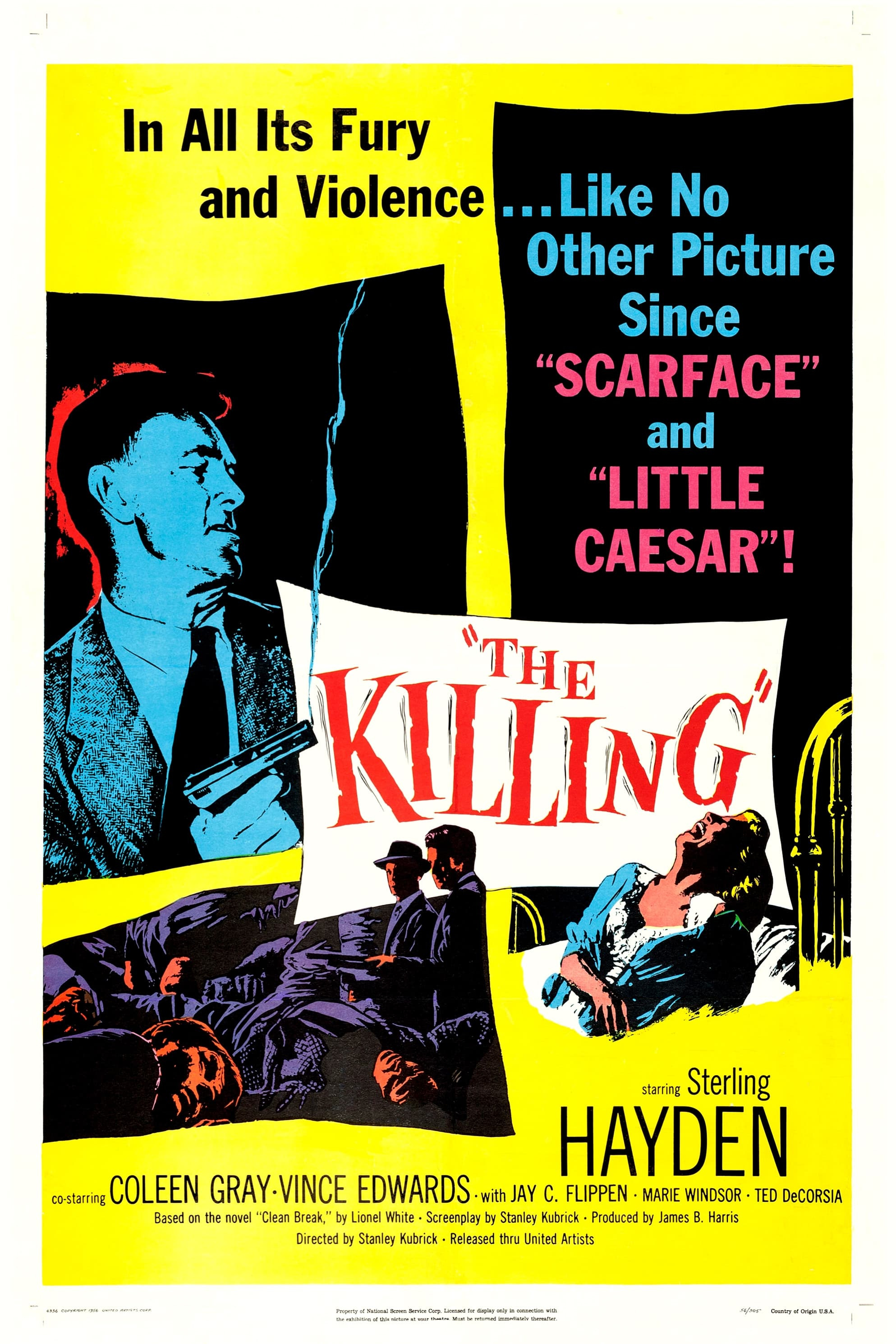
Stanley Kubrick’s The Killing, released in 1956, stands as one of the most striking crime films of its era. It announced a director who, though still early in his career, was already shaping a style built on careful composition, icy humor, and an interest in people crushed by their own schemes. Before Kubrick turned toward the grander philosophical canvases of 2001: A Space Odyssey and the savage stylization of A Clockwork Orange, he trained his eye on the tight, volatile world of small-time criminals. The Killing shows how effective he could be within the boundaries of a modest budget, a limited setting, and a formulaic genre. In this film, he bends those limitations into something tense and elegant.
The story centers on Johnny Clay, played by Sterling Hayden with his usual combination of blunt charm and a heavy-lidded weariness. Johnny exits prison with the calm assurance of a man who believes he can engineer order out of chaos. He assembles a team of specialists to rob a racetrack on a day packed with bettors, grifters, and security officers. Each man holds a specific role in a precision dependent plan. The racetrack becomes a complex trap of corridors, cash windows, stables, and observation points, and the heist requires its participants to move through those spaces with mechanical reliability. Kubrick films these preparations with clipped energy, using spare dialogue and deliberate framing to suggest how fragile the whole enterprise is.
Kubrick did not originate this story from whole cloth. The film draws from Lionel White’s novel Clean Break, published in 1955, a work that helped define the mid-century heist narrative. White, widely regarded as one of the leading architects of the caper novel, built his reputation on precision. His stories function as blueprints. Each role is assigned, each movement timed, each contingency considered. The tension comes from watching a plan strain against the unpredictable edges of human behavior. Clean Break carries that design forward with clean lines and forward momentum, presenting the heist as an engineered problem waiting to be solved.
Kubrick takes White's blueprint and subjects it to something harsher. The film does not celebrate the plan, it examines its failure. Where White’s narrative moves with hardboiled efficiency, Kubrick introduces distance, fragmentation, and a sense of inevitability. The structure loops back on itself, exposing weak points rather than concealing them. What looks precise begins to feel provisional. The heist becomes less an execution than an autopsy in progress, each scene revealing another fracture in the design. In that shift, Kubrick aligns White’s mechanics with his own emerging preoccupation. Systems promise control, yet remain vulnerable to the smallest disruption, especially when human impulse enters the equation.
Part of the film’s power comes from its unusual structure. Rather than unfolding events in a flat progression, Kubrick cuts across time. He shows scenes that overlap, contradict, or complicate what has just been shown. A dry, intrusive narrator marks the hours as if announcing the movements of aircraft, which gives the movie an oddly bureaucratic mood. The plot becomes a looping chain of cause and effect where viewers know more than any individual character. It creates a sense of tension unreliant on car chases or loud confrontations. The suspense grows from the uneasy knowledge that tiny deviations in timing can derail the entire heist.
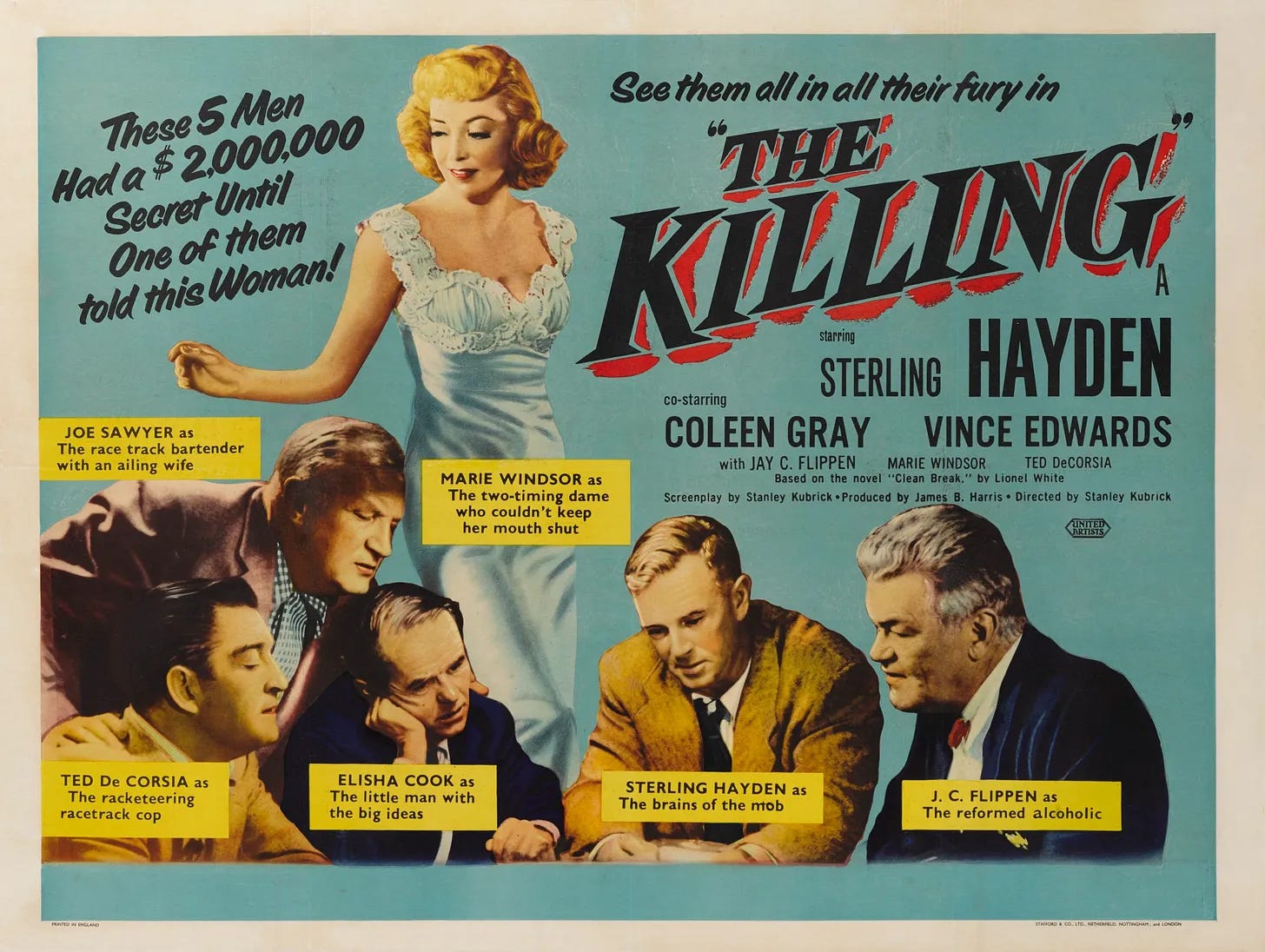
The supporting cast adds texture to this closed system. Elisha Cook Jr. gives one of his finest performances as George Peatty, a meek clerk who wants to impress his wife, Sherry, played with coiled venom by Marie Windsor. Their strained marriage brings a sour domestic strand into the larger crime plot. George’s desperation and Sherry’s ambition crack the sleek design of Johnny’s plan. Meanwhile, the men Johnny recruits, from a wrestler hired to create a diversion to a bartender willing to bend the rules for cash, serve both as pieces in Johnny’s blueprint and as individuals whose flaws carry the potential to blow everything apart. Kubrick never oversells their shortcomings. He lets glances, small hesitations, and clipped exchanges do the work.
Visually, the film is a tight study in spatial control. Kubrick uses shadows and corners to suggest traps within traps. Racehorses thunder through the frame in abrupt bursts contrasting with the stillness of the planning scenes. The racetrack itself hums with everyday activity and seeming indifference to the criminal storm brewing within it. Kubrick’s camera lingers on hallways and offices to heighten the sense the environment has its own momentum. When the heist unfolds, the cuts grow sharper and the angles more aggressive. Kubrick establishes a rhythm which carries the audience through the operation with a feeling of both confidence and dread.
The Killing’s enduring impact comes from not only the mechanics of the crime but the mood of looming collapse. Each character is guided by personal convictions or petty desires, yet when stacked together those motivations form a chain stretched to snapping point. The film treats fate as something built from human decisions, some made hastily and others made with careful calculation. Kubrick’s interest in systems, a theme he would revisit throughout his career, is already present here. These systems look sturdy until someone nudges a single gear.
Although made long before contemporary crime films embraced fractured timelines and ruthless ensemble casts, The Killing carries a modern punch. Its brisk pace, bleak humor, and cool detachment make it feel current. Many filmmakers have drawn from it, and its influence can be sensed in later heist movies where structure carries the drama. The film’s confidence also stems from Kubrick’s growing mastery of tone. He blends documentary-style detail with a crisp noir sensibility, creating something both grounded and stylized.
The Killing remains one of the strongest examples of Kubrick’s early talent. It uses the mechanics of a racetrack robbery to examine ambition, loyalty, and the quiet cracks caused from people who try to impose order on an world determined to resist control. Sterling Hayden’s sturdy presence anchors the story, yet the film’s real strength lies in Kubrick’s patient and meticulous vision. With this movie, Kubrick demonstrated he could turn a modest crime story into a tightly wound study of people pushed to the brink. It marked the arrival of a filmmaker with a rare ability to transform procedural details into something striking and memorable
Paul Bishop is the author of fifteen novels, including the award winning Lie Catchers. He is also the editor of 52 Weeks 52 Sherlock Holmes Novels—a multi-author compendium of essays regarding fifty-two of the best Sherlockian pastiches plus much more—Available on Amazon or from Genius Books...
52 Weeks * 52 Sherlock Holmes Novels